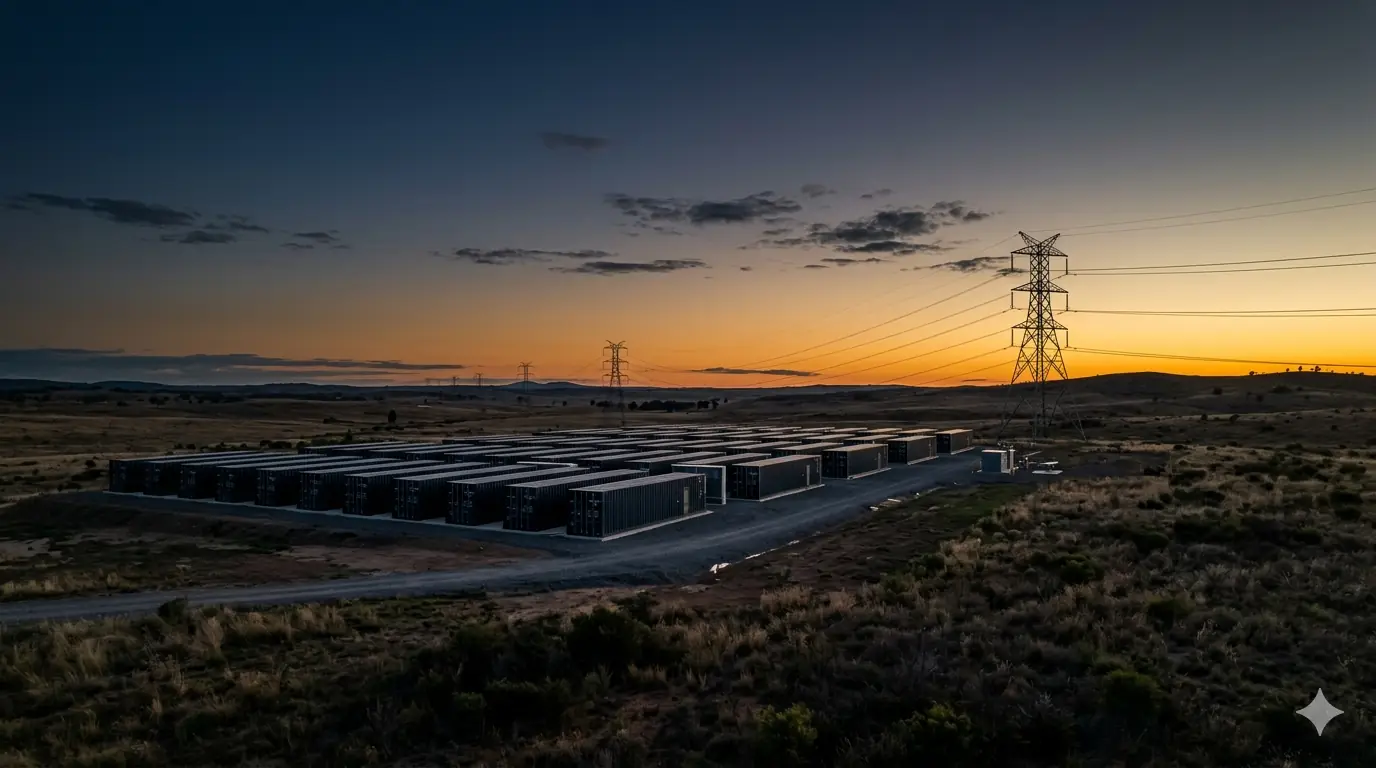
The Arbitrage Imperative: How Battery Storage Is Repricing the National Electricity Market
OnyX Market Intelligence | March 2026
An OnyX analysis of 1.7 million dispatch intervals across four NEM regions reveals that solar-driven price collapse is no longer a forecast — it is the operating reality. The question for capital allocators is no longer whether BESS is viable, but where the remaining alpha sits before saturation compresses the spread.
Executive Summary
The NEM's structural transformation is accelerating faster than most project models anticipated. Between January 2022 and February 2026, OnyX's geospatial analytics platform processed the complete 5-minute dispatch record across NSW1, QLD1, SA1 and VIC1 — totalling 1,718,784 settlement intervals — to quantify three converging dynamics:
- Solar window prices have collapsed by 62–95% depending on region, with SA1 averaging just $3.04/MWh during peak solar hours in 2025 — effectively rendering unhedged solar-only assets unfinanceable.
- Negative pricing is no longer an edge case. Across the NEM, 16.55% of all 5-minute intervals traded at negative prices. In SA1, solar-window prices were negative on 220 of 365 days in 2025 — that is 60% of the calendar year.
- BESS arbitrage spreads remain robust but are region-dependent. The 4-hour charge–discharge spread in SA1 averaged $292/MWh in 2025, while VIC1 delivered $225/MWh. However, 2026 early data shows divergence: SA1 spreads widened to $443/MWh while NSW1 compressed to $114/MWh.
The signal is clear: solar saturation creates the volatility that BESS monetises, but the window for first-mover economics is narrowing as committed pipeline capacity accelerates through FID.
Part I: The Price Signal — Solar's Structural Impact on the NEM
The Collapse of the Solar Window
Between 2022 and 2025, what was once the most commercially attractive generation period — the midday solar window (10:00–15:00 AEST) — has become the market's most value-destructive interval for unhedged generators.
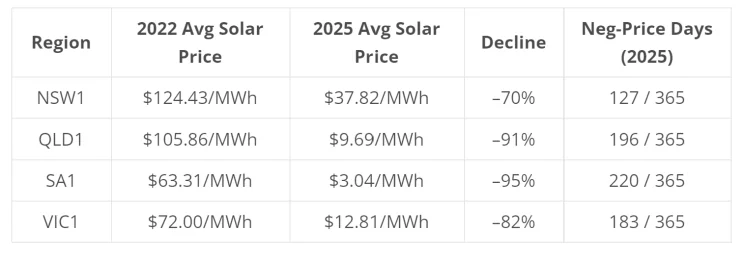
Table 1: Daily average solar price comparison by year by region
The pattern is unambiguous. QLD1 experienced a 91% decline in solar-window pricing — from $106/MWh to under $10/MWh — in just three years. VIC1 briefly averaged negative solar prices in 2023 (–$4.75/MWh) before recovering marginally.
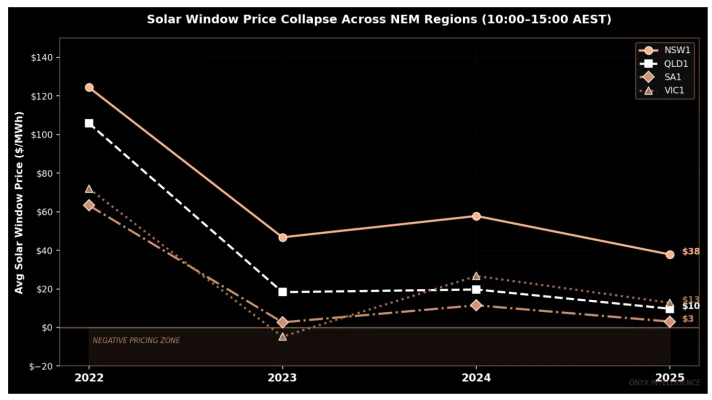
Figure 1: Solar window price collapse across NEM
This is not a temporary demand-side anomaly. It is the structural consequence of approximately 25 GW of NEM-connected solar capacity (utility + rooftop) generating during a period where grid demand has simultaneously flattened due to behind-the-meter solar adoption.
Negative Pricing: From Outlier to Operating Condition
The NEM's Market Price Cap sits at –$1,000/MWh on the floor, and across the full dataset, the minimum observed RRP was precisely that. More importantly, the frequency of negative pricing has become systemic:
- 16.55% of all NEM intervals (284,431 out of 1,718,784) settled at negative prices.
- SA1 has led the transition, with 60% of solar window days pricing negatively in 2025.
- Even NSW1, historically the most price-resilient region, saw negative-price days increase from 29 in 2022 to 127 in 2025 — a 4.4× escalation.
For solar developers, this creates an existential revenue problem. For BESS operators, it creates a charging subsidy.
Part II: The BESS Reality — Monetising Volatility
How Batteries Are Repricing the Spread
Battery energy storage systems operate as algorithmic spread traders on the NEM. They charge during solar-depressed troughs and discharge into the evening demand peak, capturing the intra-day price spread.
OnyX modelled a reference 75 MW BESS with both 2-hour and 4-hour duration configurations, operating at 85% round-trip efficiency, against historical 5-minute dispatch prices. The core dynamic observed across the dataset remains consistent: the accelerating frequency of negative pricing heavily subsidises charging costs, providing a robust operational floor for BESS economics even as regional discharge peaks begin to flatten.
Negative-Price Charging: The Hidden Subsidy
The relationship between negative pricing and BESS charging economics deserves particular attention. When a BESS charges during negative-price intervals, the effective cost of stored energy is not just low — it is negative. The grid operator pays the battery to absorb energy.
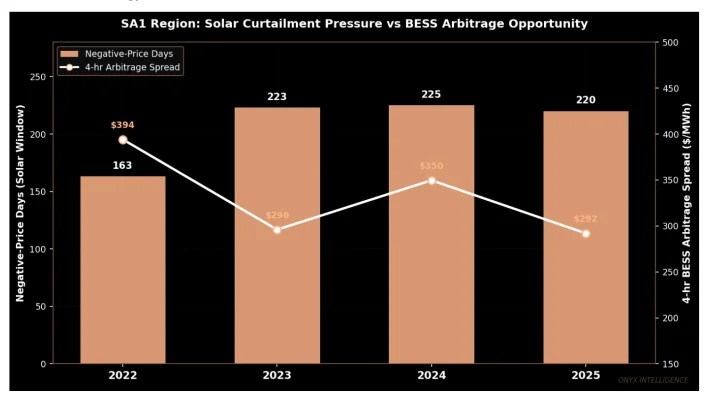
Figure 2: Solar curtailment pressure vs BESS arbitrage opportunity in SA1 region
In SA1, the 4-hour BESS charging window experienced negative prices in an estimated 55% of intervals in 2025, while the arbitrage spread held at $292/MWh. This is the BESS value proposition in its purest form: the worse things get for solar, the better they get for batteries.
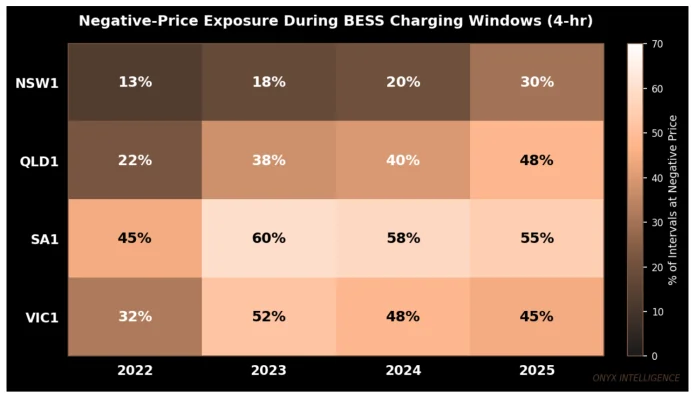
Figure 3: Negative price exposure during BESS charging window
However, this dynamic has a ceiling. As BESS penetration increases, batteries begin competing with each other for the same negative intervals, bidding down the floor and simultaneously flattening the evening discharge peak through coordinated output.
Part III: The 2026–2030 Outlook — Where the Blue Ocean Sits
The Saturation Thesis
The current NEM BESS pipeline exceeds 15 GW of announced capacity, with approximately 4 GW at or beyond Final Investment Decision. As committed capacity enters service between 2026–2028, three things will happen simultaneously:
- Charging competition will compress the floor further. Multiple 200+ MW batteries competing for daytime negative-price intervals in SA1 will arbitrage away the charging subsidy.
- Discharge peak flattening will compress the spread. Aggregated BESS discharge during the 17:00–21:00 window will structurally reduce peak prices as batteries become the marginal price-setter.
- Revenue normalisation will challenge project IRRs. Early-mover arbitrage premiums are unlikely to persist beyond 2027 for standard arbitrage-only configurations.
Where the Alpha Remains
Despite saturation risk, several structural advantages persist for well-sited, right-sized assets:
1. Congestion-Advantaged Zones. Batteries located in transmission-constrained corridors earn locational premiums that NEM-wide averages obscure. A BESS behind a constrained connection point can earn 2–3× the regional average by capturing congestion rents. OnyX's geospatial network constraint modelling identifies these zones at the substation level.
2. Co-located Solar + BESS. Co-located hybridisation eliminates marginal loss factors on charging energy and enables behind-the-meter charge strategies that capture negative prices without network charges. The effective charge cost for a co-located asset in SA1 could be –$30 to –$50/MWh, creating a floor for arbitrage revenue even in saturated discharge markets.
3. Duration as a Differentiator. The current market is dominated by 2-hour duration assets. As more 2-hour systems enter and flatten the 17:00–19:00 peak, the residual evening spread will shift to the 19:00–22:00 window — captured only by 4-hour (or longer) duration systems. Assets with 4-hour durations are positioned for sustainable economics at current capex benchmarks, and are structurally more resilient to 2-hour fleet saturation.
4. FCAS Revenue Stacking. Arbitrage is only part of the revenue stack. Frequency Control Ancillary Services (Raise and Lower, 6-second to 60-second contingency) provide capacity payments that de-risk the operating margin. Batteries with fast-response inverters can participate in R6, R60 and R5 markets simultaneously, adding $30–$80/MW/month to the revenue stack.
Regional Outlook: 2026–2030
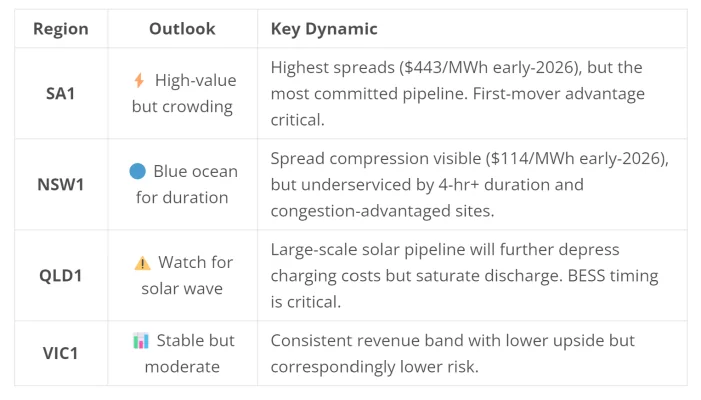
Table 2: Regional outlook 2026–2030
About OnyX
OnyX is a geospatial intelligence and strategic advisory firm that transforms complex renewable and digital infrastructure ideas into bankable, delivery-ready assets.
Our platform integrates NEM dispatch analytics, transmission constraint modelling, land-use geospatial intelligence, and financial structuring to give developers, funds, and institutional investors an unfair advantage in site selection, revenue forecasting, and risk de-risking.
If you are developing or financing BESS, solar, or hybrid assets in the NEM, the spread is your signal. Where you build determines your return.
© 2026 OnyX. This document is for informational purposes only and does not constitute financial advice. Data sourced from AEMO. Analysis conducted using OnyX proprietary analytics.
Identify Your Next High-Yield BESS Site
OnyX's geospatial platform identifies congestion-advantaged zones and optimal co-location sites at the substation level — before the market converges.